
The 5th Annual FinTech West Student Talent Showcase
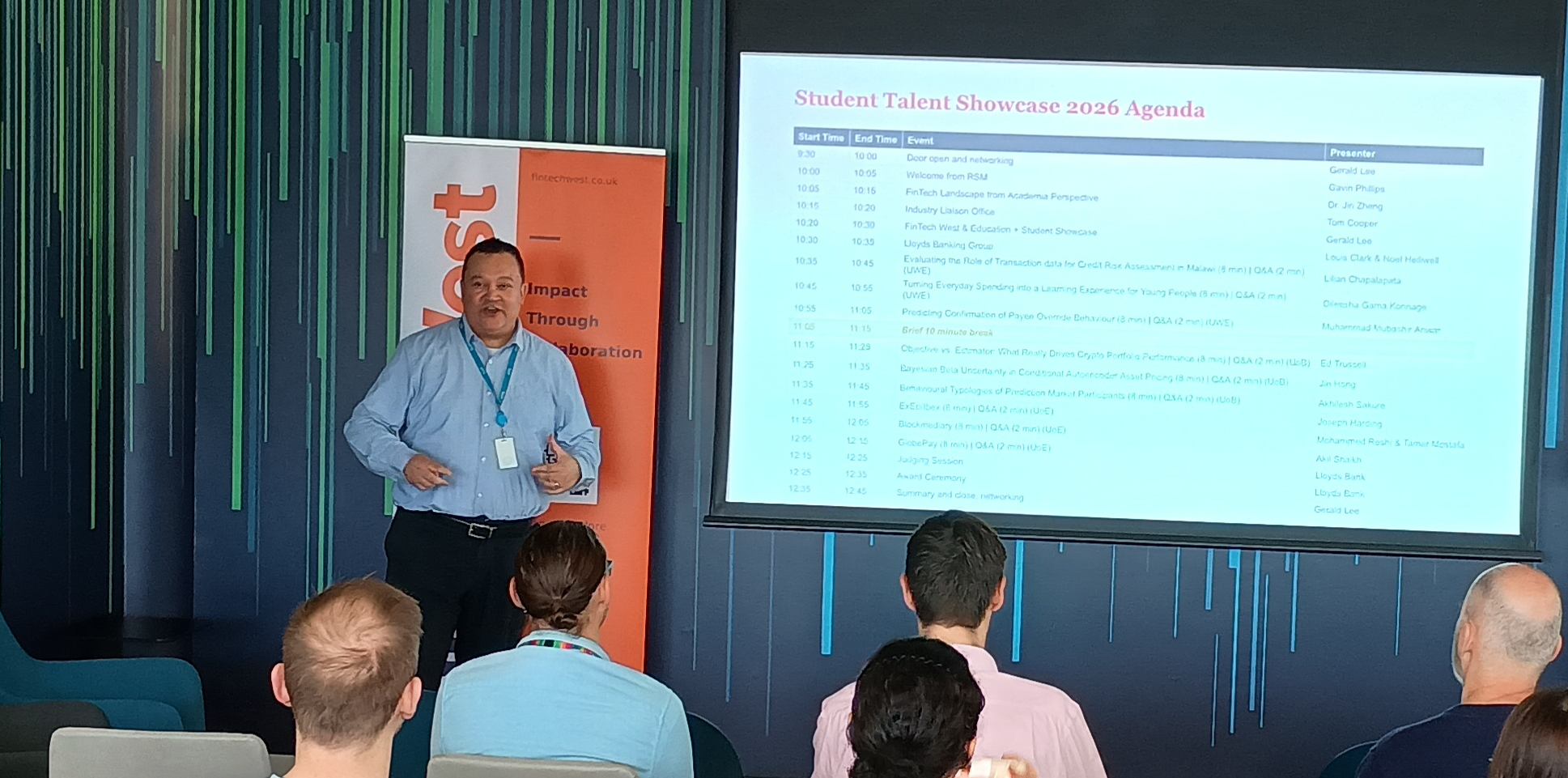
We were back at RSM for the fifth annual FinTech West Student Talent Showcase. This event remains one of our favourites because it gives us the opportunity to hear directly from some of the fantastic student talent coming through our region’s universities.
There was an important difference this year too. For the first time we were joined by students from the University of Exeter, alongside our long-standing partners at the University of Bristol and UWE Bristol. So what started five years ago as a way of showcasing some of the great FinTech work taking place in Bristol is beginning to reflect the depth of talent across the wider South West.
As ever, a big thank you to RSM for hosting us and to Gavin Phillips for welcoming everyone to the event.
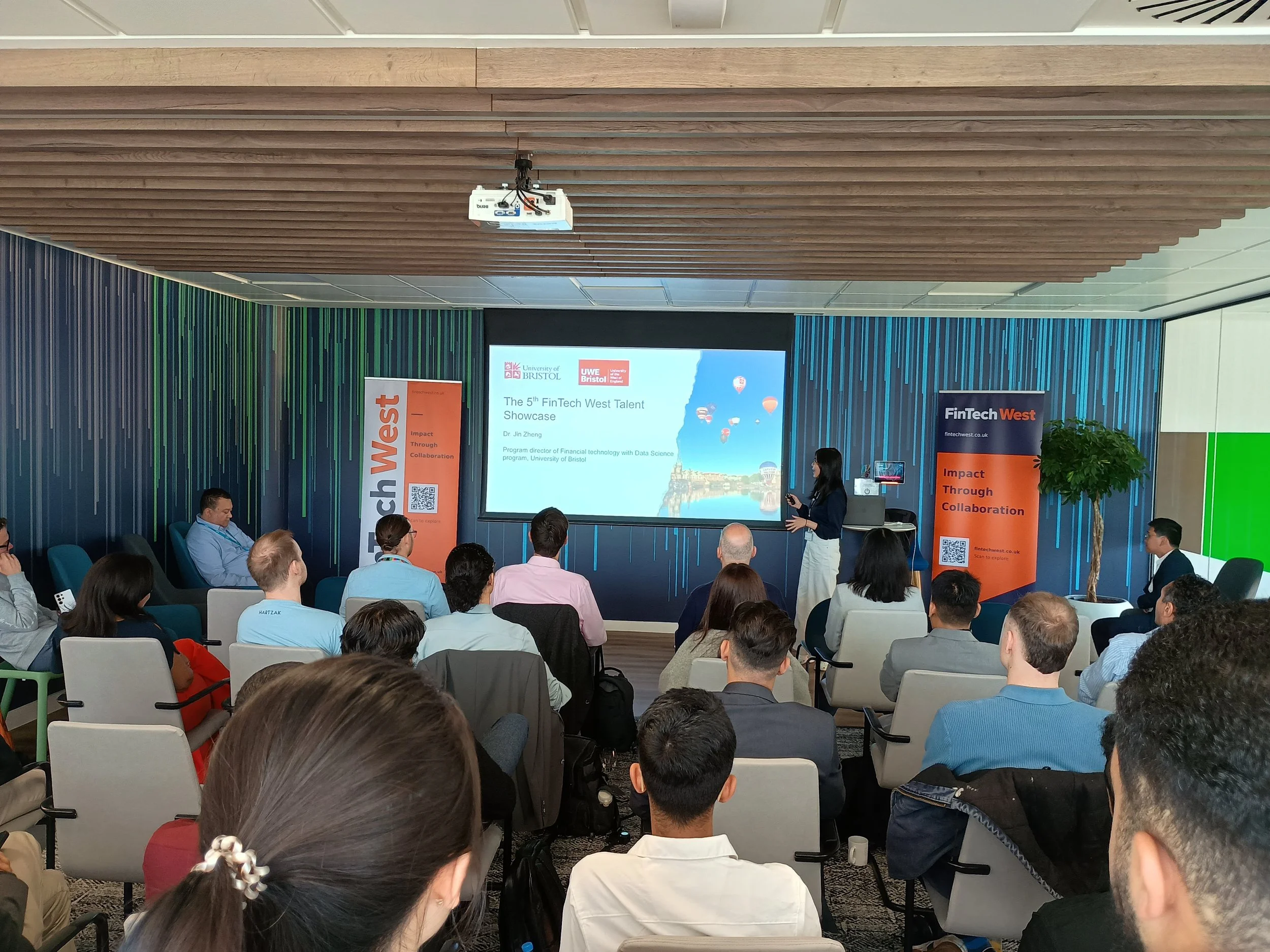
We started with Dr Jin Zheng, Programme Director for the MSc Financial Technology with Data Science at the University of Bristol, who gave an academic perspective on the changing FinTech landscape and the increasingly important relationship between finance, data, software and AI.
It was also a useful reminder of just how much the FinTech education landscape has developed over the lifetime of these Showcase events. There are now a growing number of FinTech, data science and AI-related programmes across the region, with universities increasingly working directly with industry to make sure students get exposure to real-world problems rather than purely academic exercises.
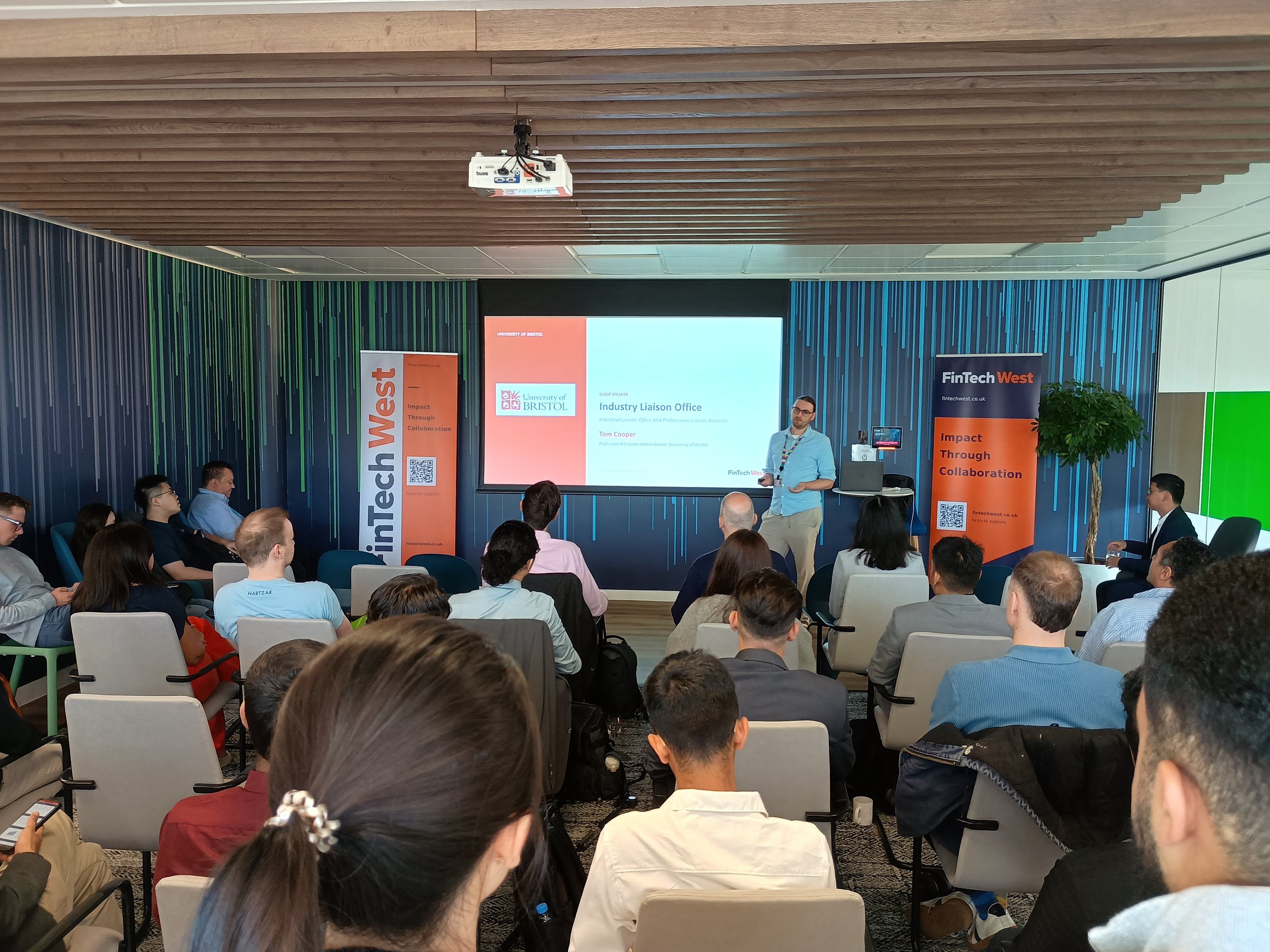
Tom Cooper from the University of Bristol’s Professional Liaison Network then explained one of the easiest ways businesses can get involved: by providing real industry challenges for students to work on as part of their studies.
It really is a fantastic opportunity. Organisations can put forward a problem or area they would like investigated and have bright, motivated students spend weeks exploring it, supported by their university. The students gain experience of solving real problems and industry gets fresh thinking and research around a challenge it actually cares about. There is no financial cost to the organisation although some time and engagement is obviously needed to make the collaboration worthwhile.
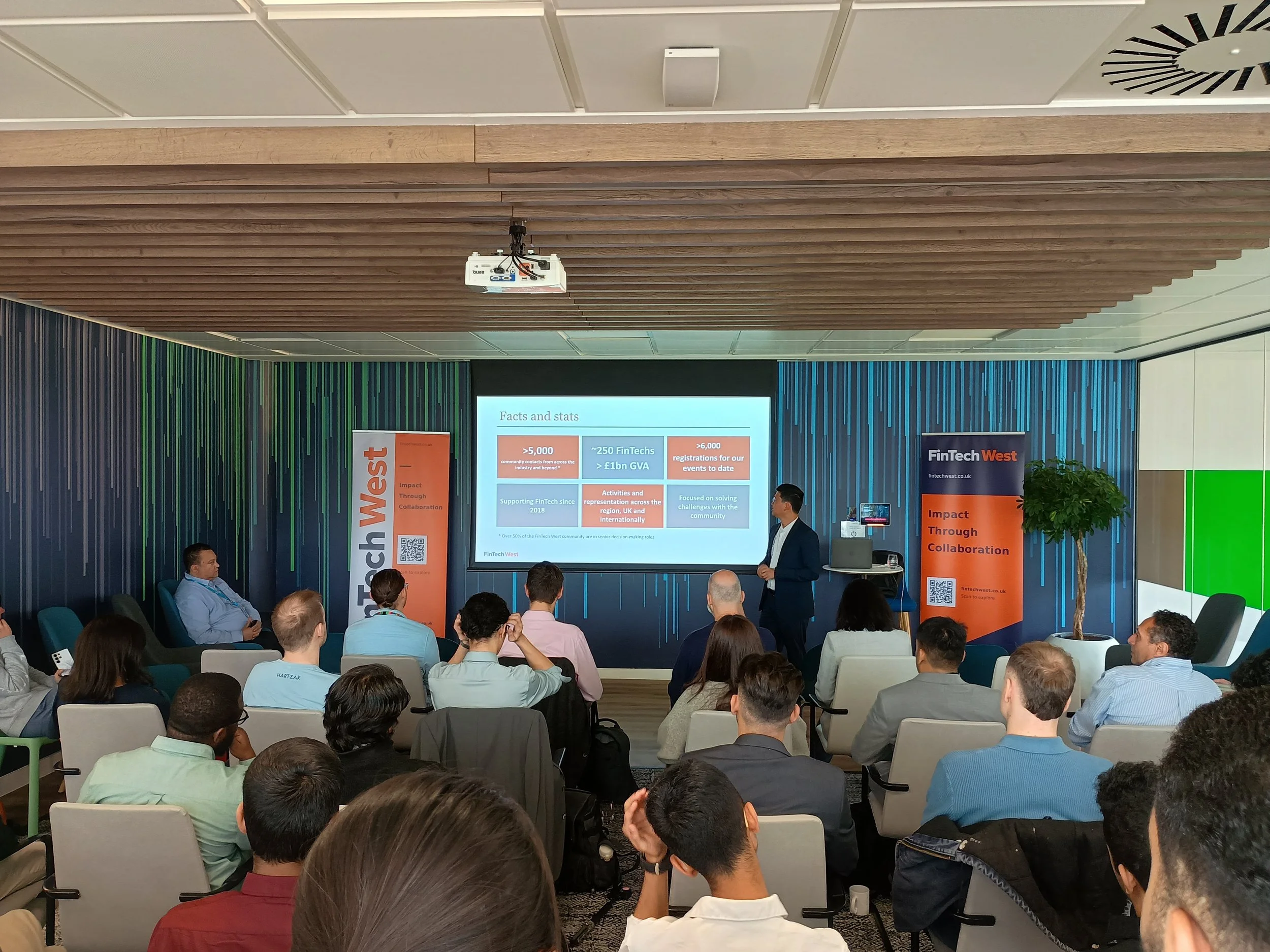
Our own Gerald Lee then provided an overview of FinTech West’s work, particularly around connecting industry, academia and talent. Academic engagement has become a significant part of what we do, ranging from student projects and research collaboration through to supporting spinouts, collaborative funding bids and creating opportunities for students to engage directly with industry.
And then it was time for the students.
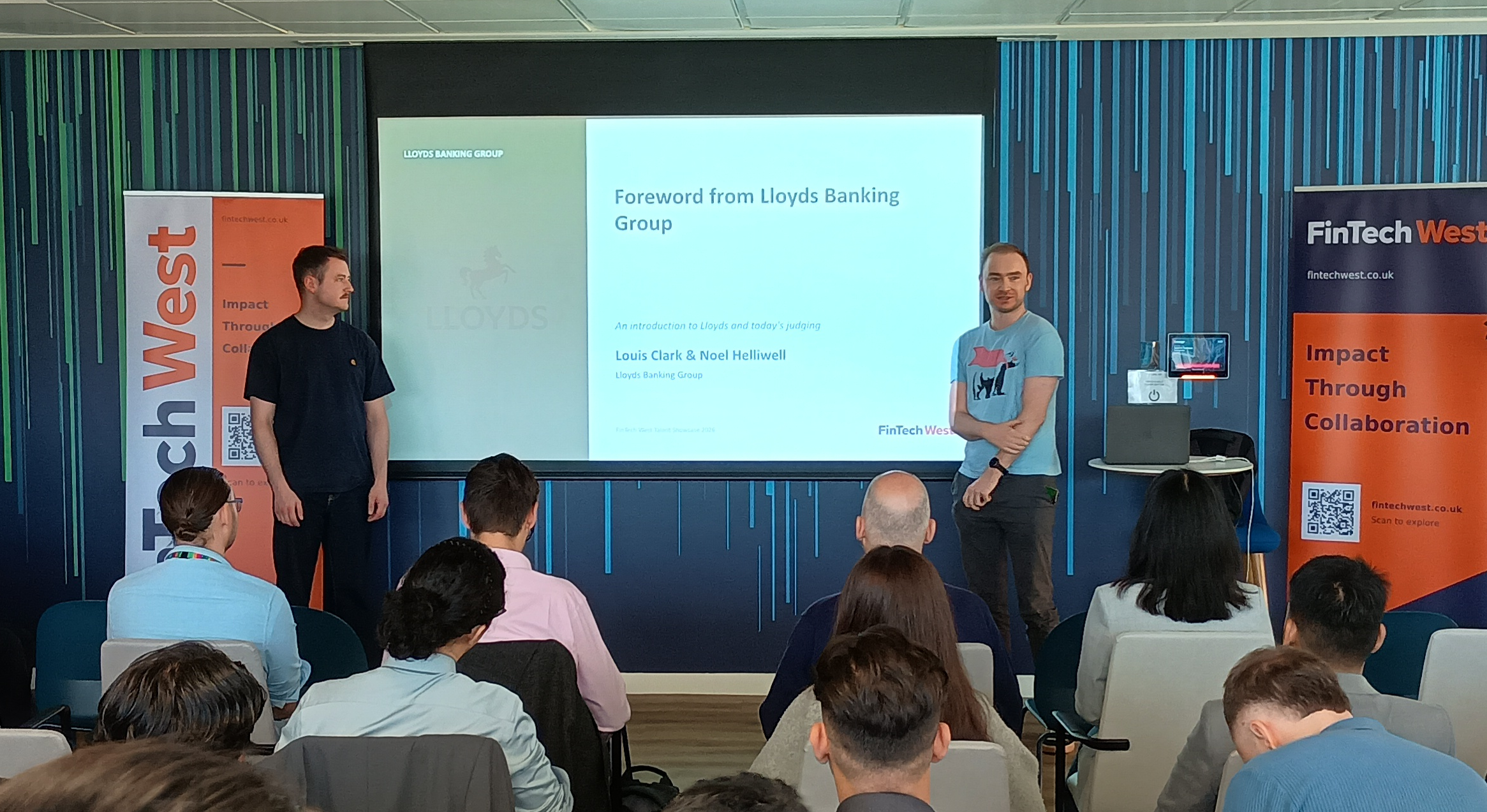
Before they started, Louis Clark and Noel Helliwell from Lloyds Banking Group explained that they would once again be judging the presentations. This year there were two awards, Most Innovative Idea and Best Delivery with originality, presentation quality and the clarity of the supporting material all taken into account.
UWE Bristol
First up was Lilian Chapalapata with “Evaluating the Role of Transaction Data for Credit Risk Assessment in Malawi”.
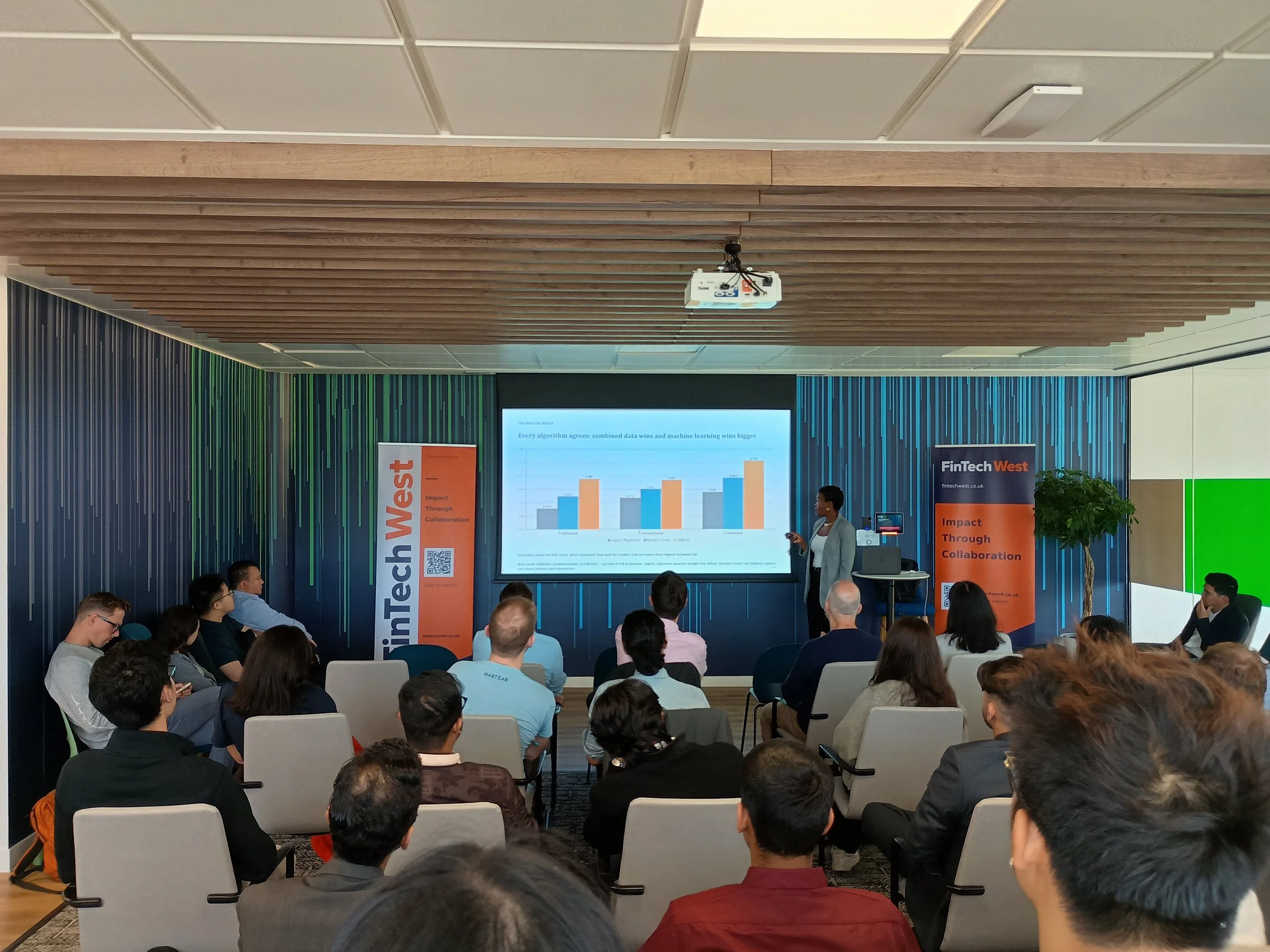
Lilian’s research looked at whether the digital footprints already being created through everyday financial activity could improve credit decisions. This is particularly relevant in markets such as Malawi where traditional credit data can be limited but mobile money and other digital transactions are increasingly widespread.
Her work compared traditional credit data with transactional and alternative data and then combined the two using different machine-learning approaches. The interesting finding was that the combined data performed considerably better reinforcing the idea that the information sitting inside transaction histories could become a valuable part of assessing creditworthiness.
There are some potentially significant implications here, particularly around financial inclusion. If lenders can safely make better use of the financial behaviour people already demonstrate, access to credit need not depend quite so heavily on having an extensive traditional banking history.
Next was Dileesha Gama Konnage and a project and business opportunity with the memorable name Dead Broke.
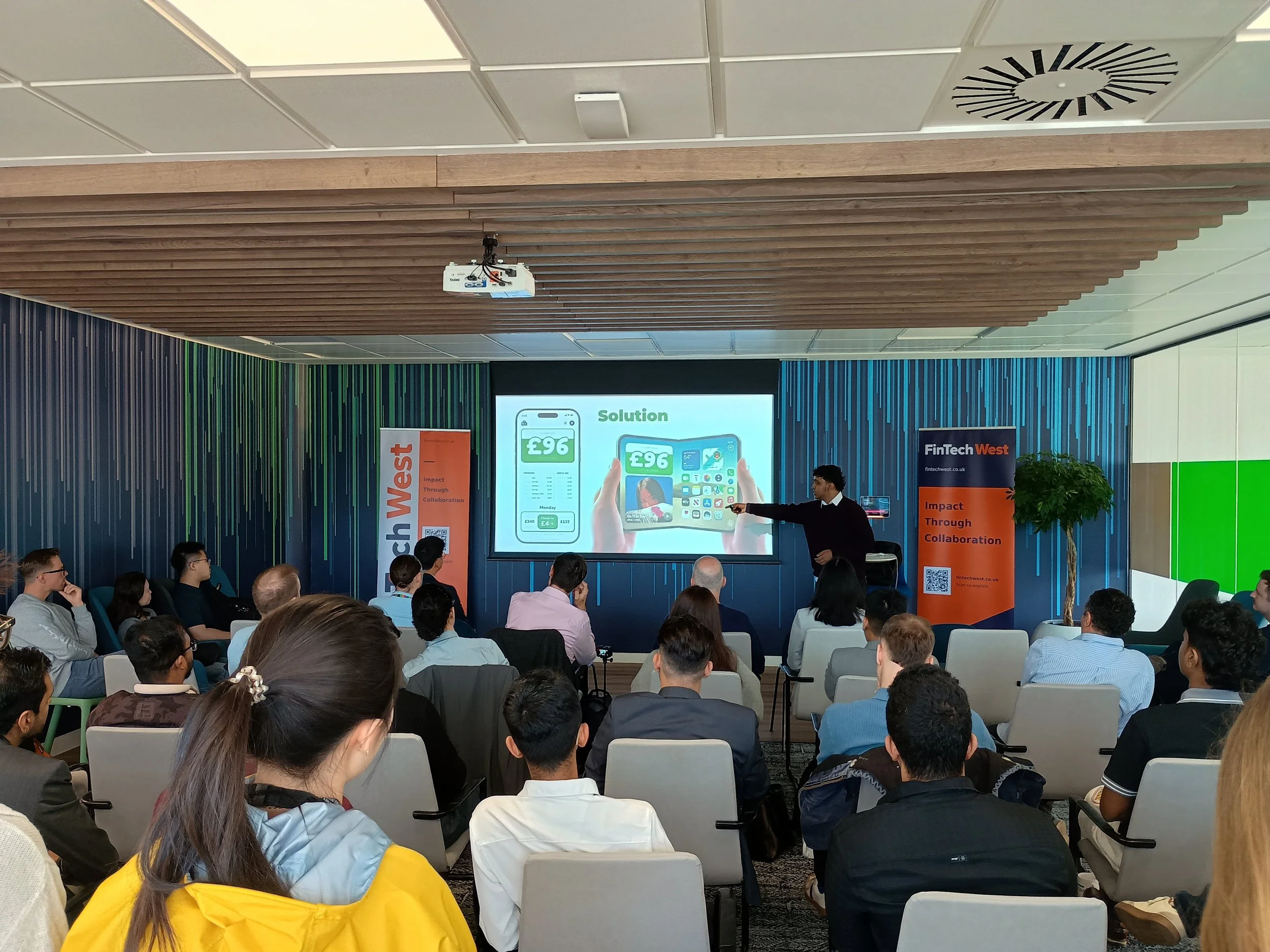
The starting point was a deceptively simple question: instead of personal finance apps continually telling us where our money went, could technology help us answer the much more useful question, “Can I afford this next decision?”
His research highlighted the low financial resilience of many younger adults and the fact that people often recognise overspending only after it has happened.
Dead Broke was designed around a simple “Left to Spend” figure, making the amount that can safely be spent immediately visible, alongside features such as small savings check-ins designed to turn saving into a regular habit. It was particularly good to see that this wasn’t just an idea, Dileesha had developed and tested the concept with users and used that feedback to understand which features genuinely changed behaviour.
It was a great example of taking a fairly complicated financial problem and trying to make the answer extremely simple for the user.
Our third UWE presentation came from Muhammad Mubashir Anwar, looking at “Predicting Confirmation of Payee Override Behaviour”.
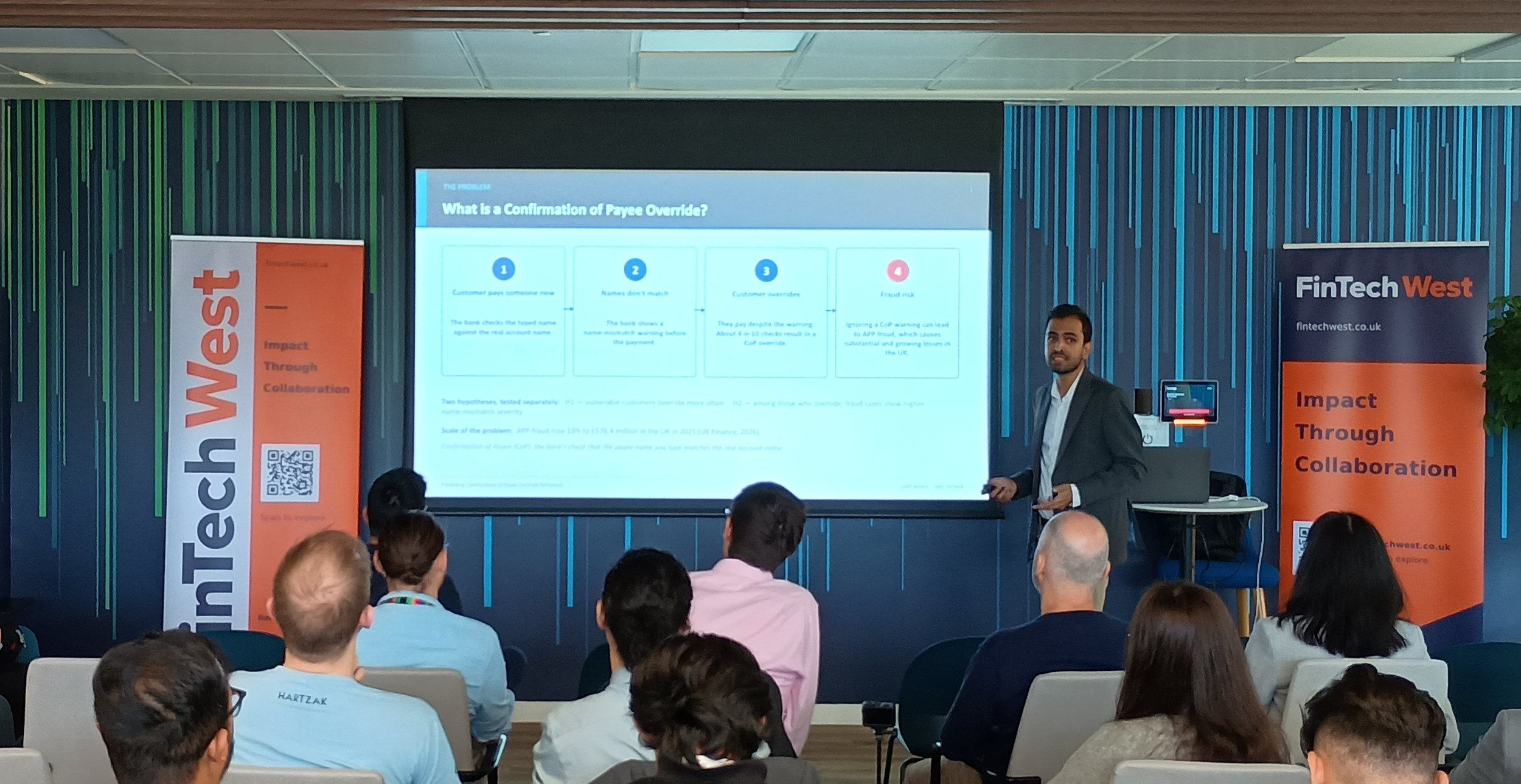
Most of us will have seen Confirmation of Payee in action: you enter the details of somebody you want to pay, your bank tells you the account name doesn’t quite match and you then decide whether to continue anyway.
Muhammad used synthetic data from the FCA Digital Sandbox to investigate what happens when customers override those warnings and whether machine learning could identify where greater intervention might be justified.
One of the most interesting conclusions was that trying to predict who will override a warning is actually quite difficult. Identifying which overrides appear most dangerous is much more useful. Large discrepancies between the name entered and the actual account name were a particularly strong fraud indicator.
His work therefore proposed a tiered approach: allow clearly low-risk transactions to proceed with minimal additional friction, provide stronger warnings where risk increases and require additional verification for the highest-risk cases.
Importantly, the model deliberately avoided relying on characteristics such as income, employment or vulnerability. That introduced a very practical discussion around how fraud prevention can become more intelligent without creating unfair treatment for particular groups.
University of Bristol
We then moved to the University of Bristol, beginning with Ed Trussell and “Objective vs. Estimator: What Really Drives Crypto Portfolio Performance?”
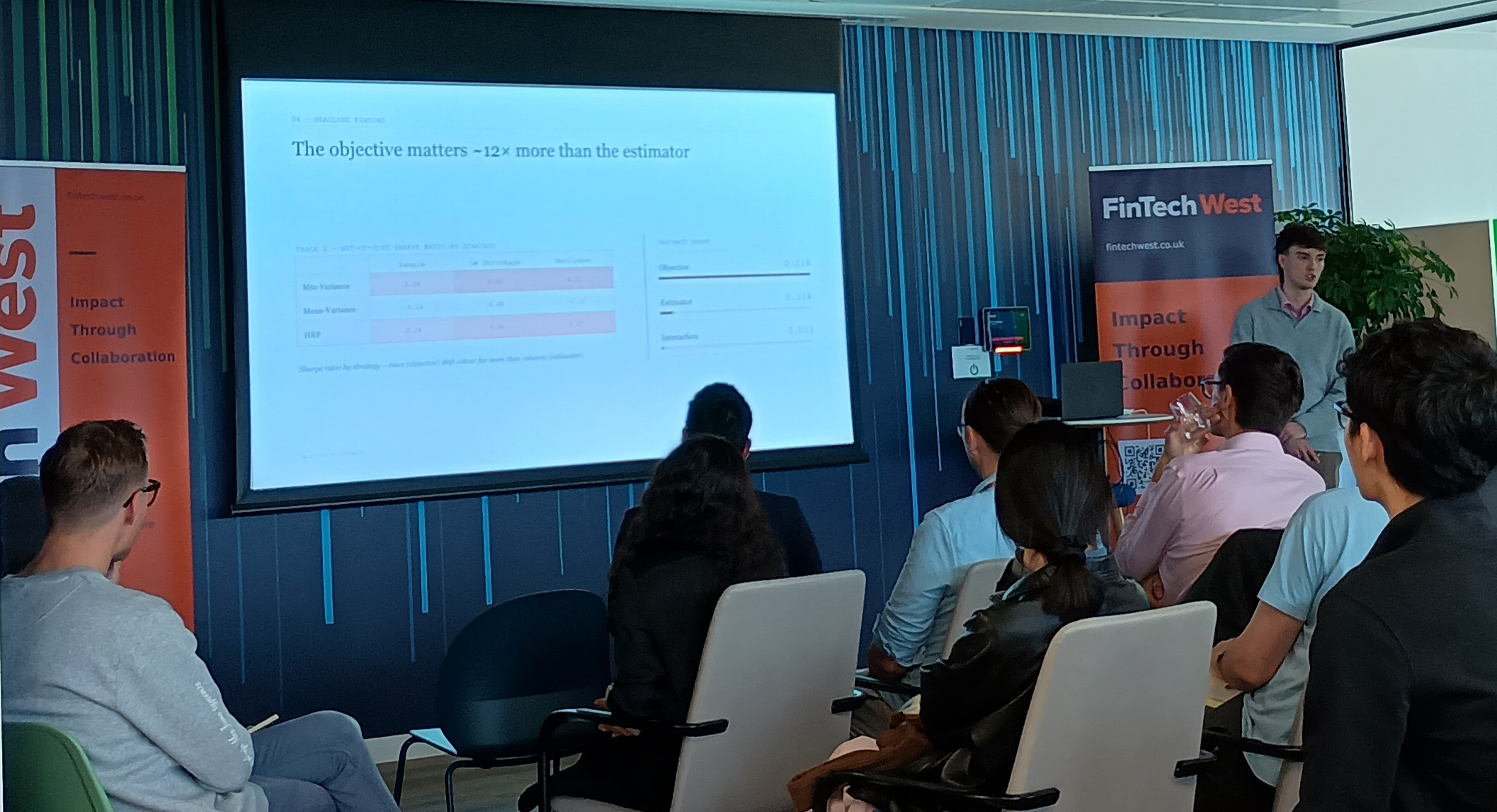
Portfolio optimisation can become extremely complicated very quickly but Ed boiled his research down to a fascinating question: when sophisticated investment strategies fail, is the problem the optimisation model itself or the estimates being fed into it?
Using cryptocurrency markets as a particularly demanding test environment, he compared different portfolio optimisation approaches and different methods of estimating risk.
His headline finding was striking: the choice of objective mattered around 12 times more than the choice of estimator.
There was another interesting dimension too. Performance changed according to the type of market. During the crypto bull market, sophisticated optimisation struggled to outperform simple equal weighting, whereas in the more mature post-ETF environment risk-based strategies became substantially more effective.
In other words, spending ever more time refining the data going into a model may be less important than making sure you have chosen the right model in the first place.
Jin Hong followed with “Bayesian Beta Uncertainty in Conditional Autoencoder Asset Pricing”.
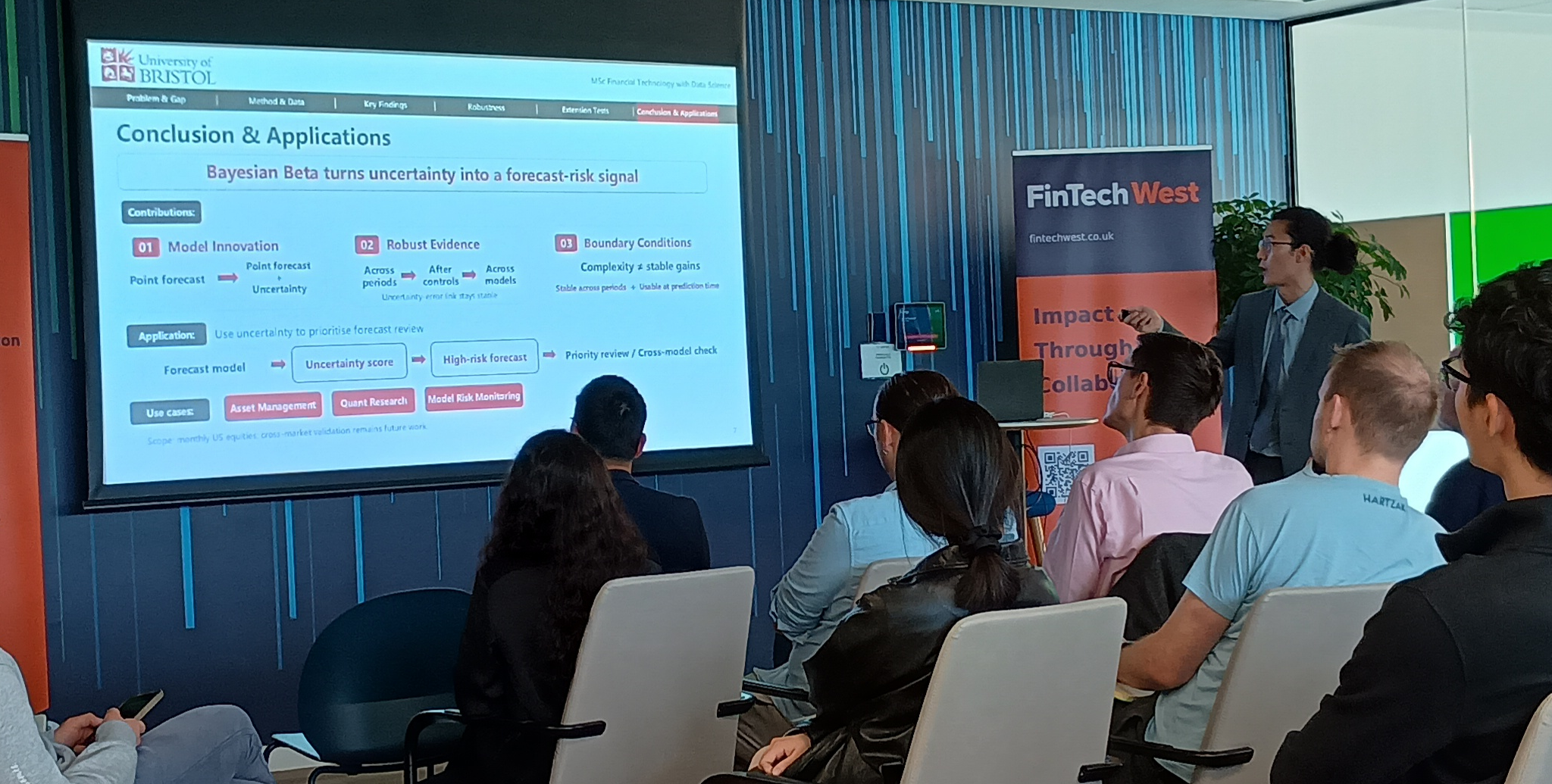
That title probably wins the award for requiring the most concentration before coffee but the underlying issue is extremely relevant.
Financial models normally produce a forecast, effectively telling us what they think is going to happen. Jin’s question was whether they should also tell us how uncertain they are about that forecast.
By extending an asset-pricing model to include Bayesian uncertainty, the research showed that greater uncertainty was associated with larger subsequent forecasting errors. Crucially, that relationship remained visible across different time periods and different models.
That means uncertainty itself can potentially become a useful signal. Rather than simply accepting every model prediction equally, investment or risk teams could identify forecasts where the model itself is effectively saying, “You might want to look at this one more carefully.”
It was a highly technical piece of research with a surprisingly practical conclusion around asset management, quantitative research and model-risk monitoring.
Our final University of Bristol presenter was Akhilesh Sakure, with “Behavioural Typologies of Prediction Market Participants”.
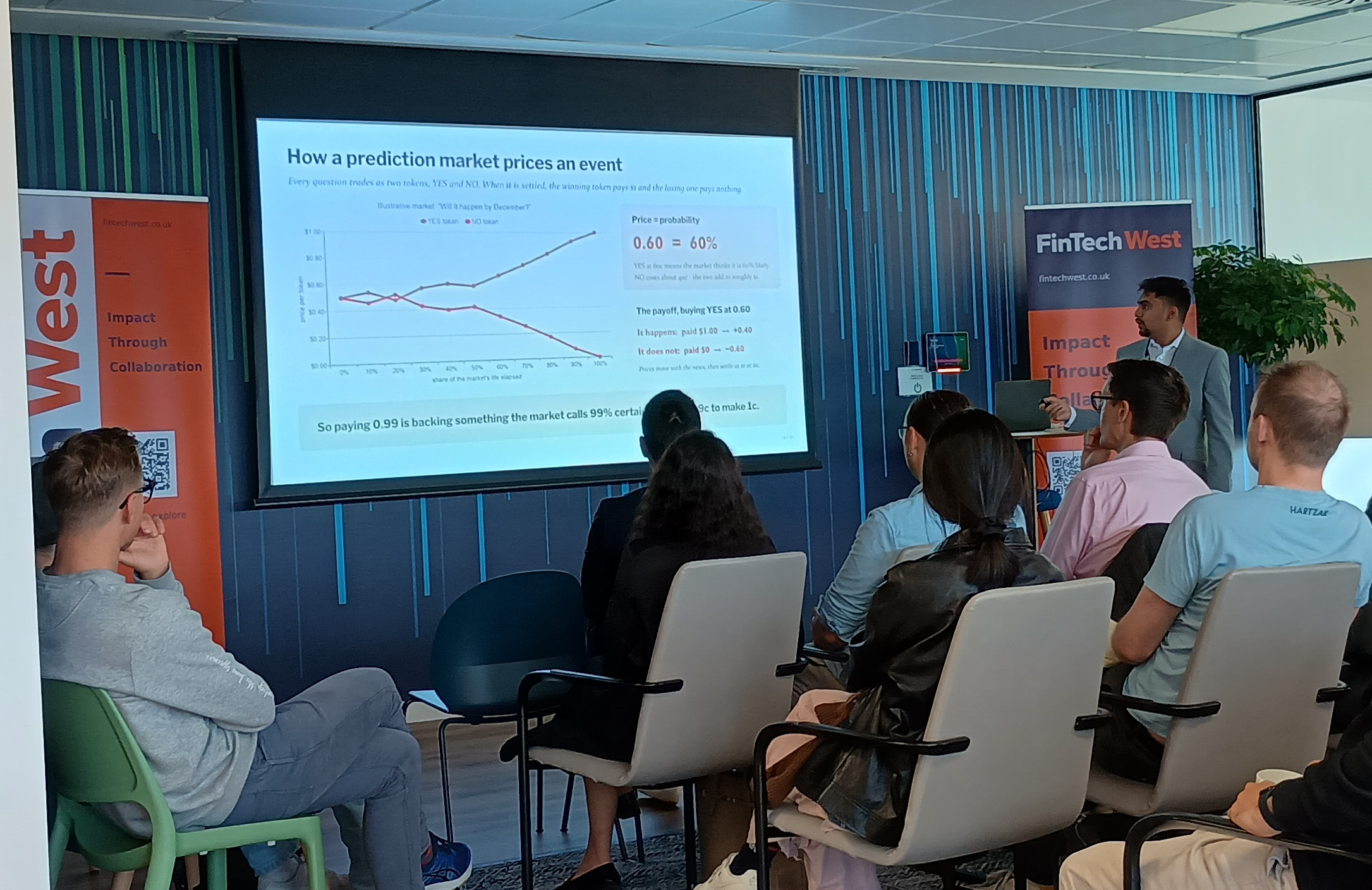
This involved analysing an extraordinary 1.23 billion on-chain trades from prediction market Polymarket and looking at how different types of participants actually behave.
Akhilesh identified different behavioural groups based on factors such as how frequently people traded, when they entered a market and the prices they were prepared to pay, deliberately leaving profitability out of the clustering so that performance could then be tested independently.
The really interesting discovery came when looking at the conventional measure of whether somebody was a successful prediction-market trader.
A standard “win rate” could actually produce the opposite conclusion because traders who sold their positions before the eventual outcome was known could be recorded as successful even if the event they had effectively predicted subsequently went the other way.
Once performance was measured only on positions actually held to resolution, the ranking changed dramatically.
It is a useful lesson well beyond prediction markets: before trusting any performance measure, make sure it is genuinely measuring what you think it is measuring.
University of Exeter
And then came another first for the Showcase as we welcomed three presentations from the University of Exeter.
Joseph Harding presented Ibex Credit, a concept for a secure and portable financial credential.
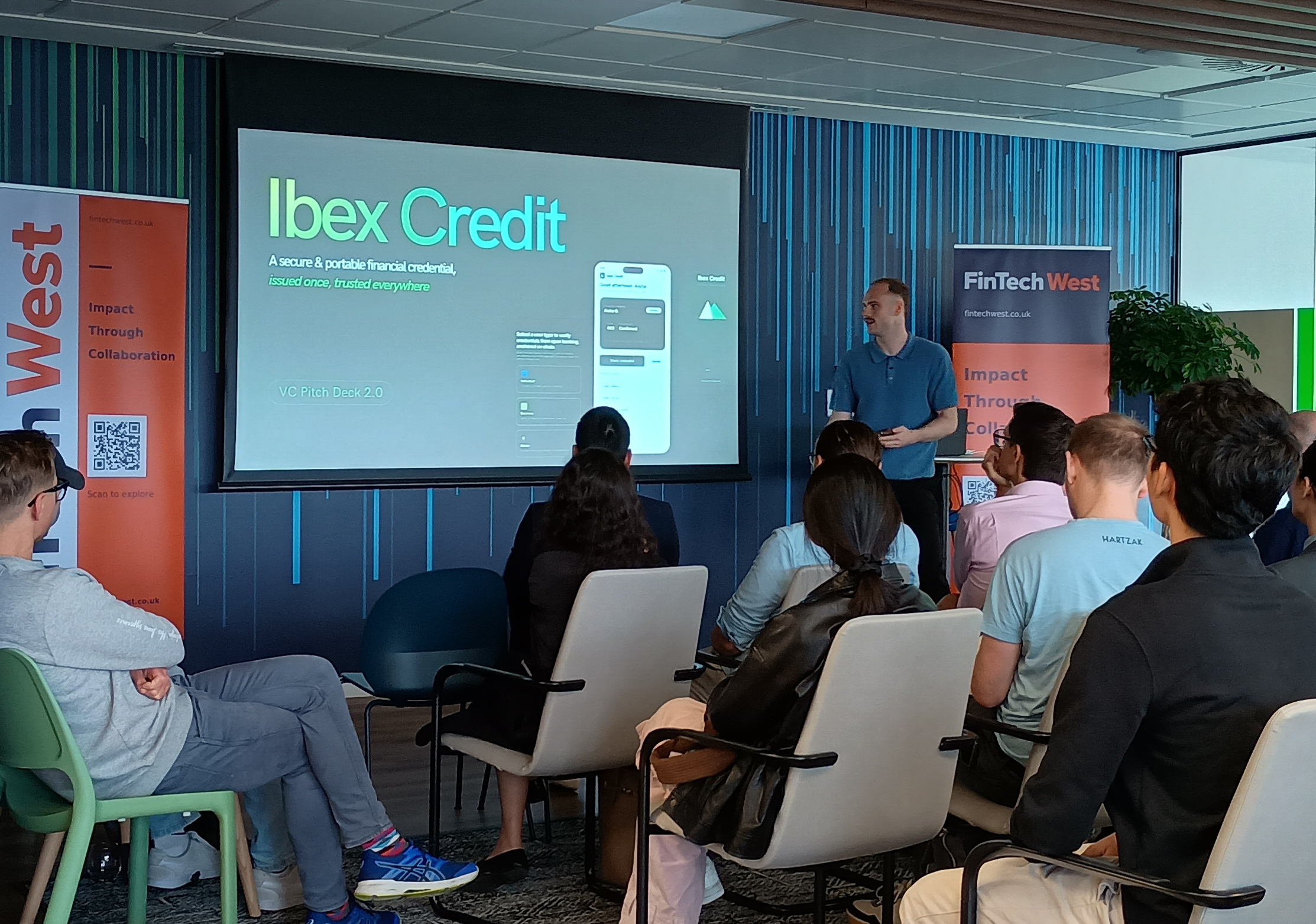
The problem it addresses will be familiar to almost any business or individual who has been through a financial onboarding process: the same documents and information get requested repeatedly, often being emailed backwards and forwards, becoming outdated and creating unnecessary verification work for everyone involved.
Ibex Credit turns that around by creating a portable credential which can be verified and reused rather than rebuilding somebody’s financial identity from scratch every time.
The team had thought through not just the technology but the user experience, compliance requirements, commercial model and potential routes to market. It was particularly interesting to see something that could reduce friction for the customer while potentially reducing verification effort for financial organisations at the same time.
Next were Mohammed Reshi and Tamer Mostafa with Blockmediary, tackling a very different problem: trust in international trade.
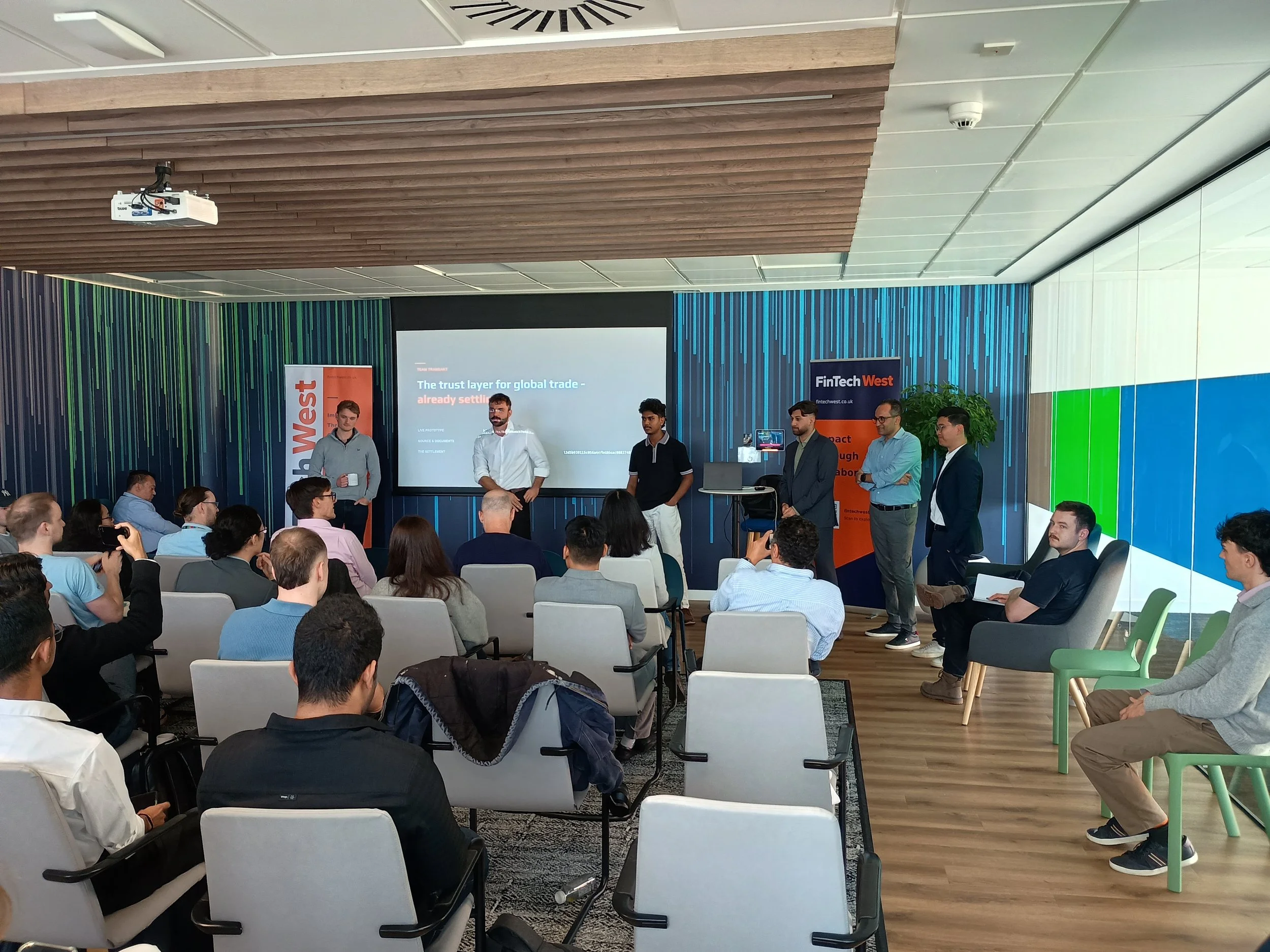
Traditional documentary credit gives buyers and sellers confidence when trading across borders but the cost and administration involved can make it uneconomic for smaller transactions. That leaves SMEs with an awkward gap where a transaction may be too large to undertake simply on trust but too small to justify conventional trade-finance processes.
Blockmediary uses programmable escrow to try to fill that gap. Buyer funds are locked and released when the agreed documentary conditions have been satisfied.
What made the presentation particularly impressive was that this had moved well beyond theory. The team has already completed an end-to-end settlement using real funds on a public blockchain.
It is a great example of identifying a genuine market problem, understanding why existing approaches do not solve it economically and then using new technology to rethink the process.
Finally, Akil Shaikh presented GlobePay, designed to simplify payments to international freelancers.
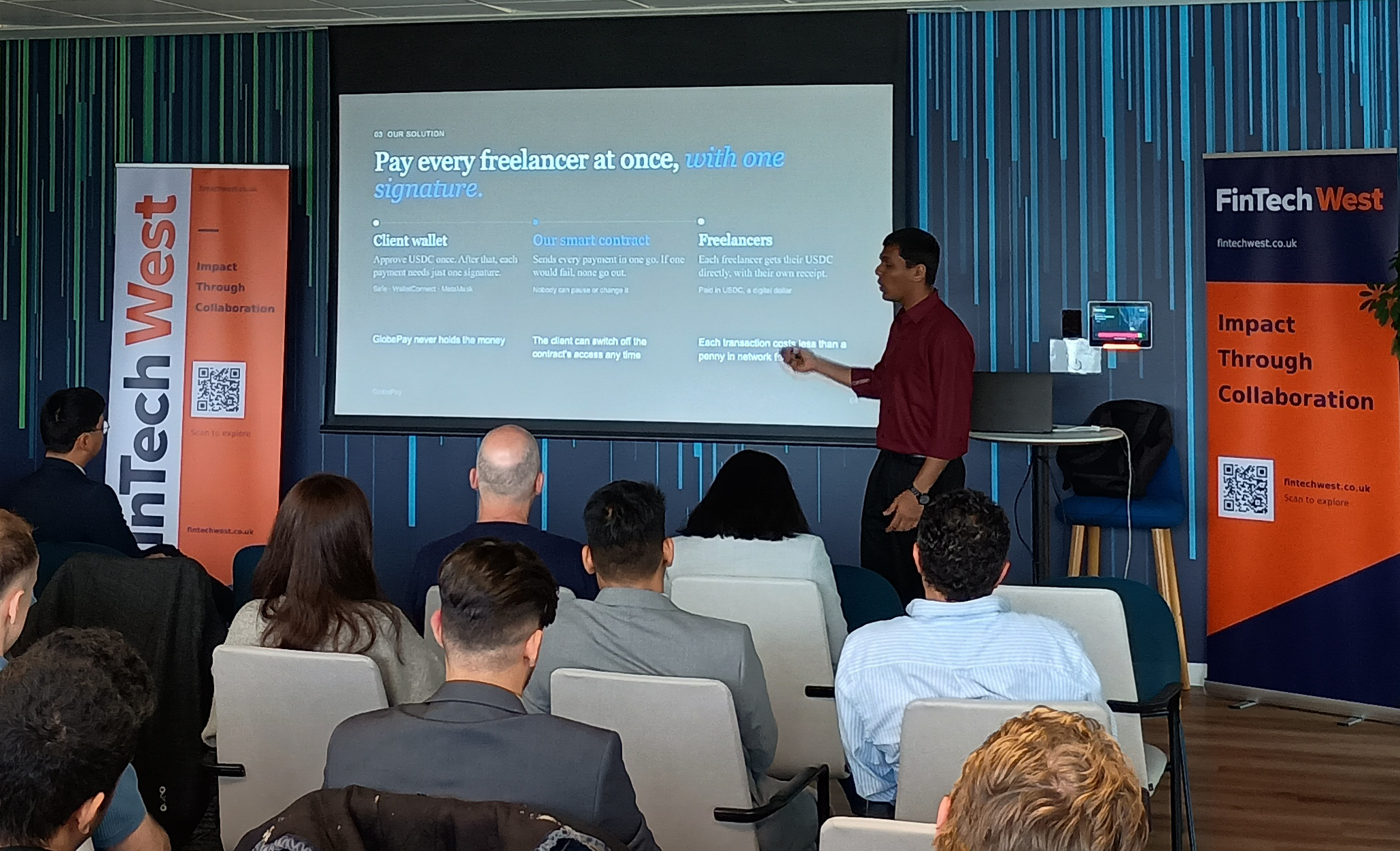
The example was straightforward: if a business works with 30 freelancers around the world, why should paying them mean making 30 separate bank transfers, dealing with different banking systems and fees and manually checking every payment?
GlobePay aims to enable a company to make those payments together, with the underlying smart contract distributing the funds directly to authenticated freelancers using USDC.
Again, the presentation was very product-focused. Akil demonstrated the payment workflow, invoice handling, wallet checks, audit trail and safeguards designed to catch problems before the money moves.
The phrase used throughout the presentation summed it up rather nicely: “From the client’s wallet to every freelancer. Nothing in between.”
That brought nine remarkably varied presentations to an end spanning credit risk, financial wellbeing, fraud prevention, crypto investing, asset pricing, prediction markets, digital identity, international trade and global payments.
And that breadth is really what makes the Student Talent Showcase so enjoyable. These are not nine students all looking at variations of the same academic problem. Some are producing deep quantitative research, some are applying machine learning to financial challenges and others are already building products which could potentially become businesses.
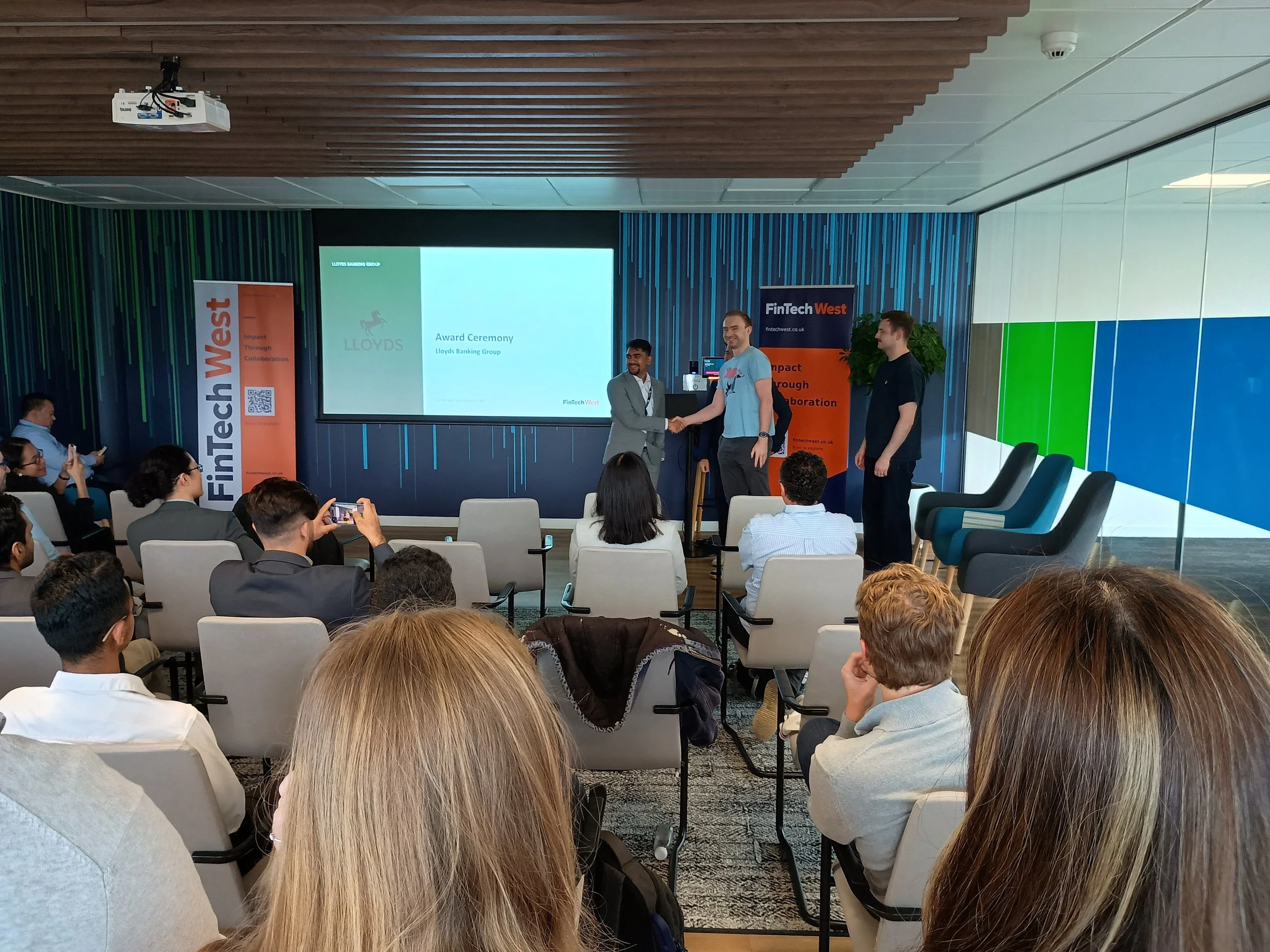
After a short judging session, Gerald, with Louis and Noel from Lloyds Banking Group announced Dileesha Gama Konnage as the winner of Most Innovative Idea and Akhilesh Sakure as the winner of Best Delivery for the Individual category. They also announced Mohammed Reshi as the winner of Most Innovative Idea and Joseph Harding as the winner of Best Delivery for the group category, with some generously donated vouchers from Lloyds going to the winners.
Another fantastic Student Talent Showcase and a huge thank you to RSM for once again hosting us, Lloyds Banking Group for supporting the judging and awards, and of course the University of Bristol, UWE Bristol and University of Exeter teams who made it possible.
And kudos to Gerald Lee who organised the entire event from start to finish. Only three years ago, he was himself a student presenting his dissertation project!
Most of all, thank you to all nine of the student presenters for being prepared to stand up in front of an industry audience and share their work. If the quality and breadth of what we heard is any indication, the future FinTech talent pipeline across the South West is looking pretty healthy.
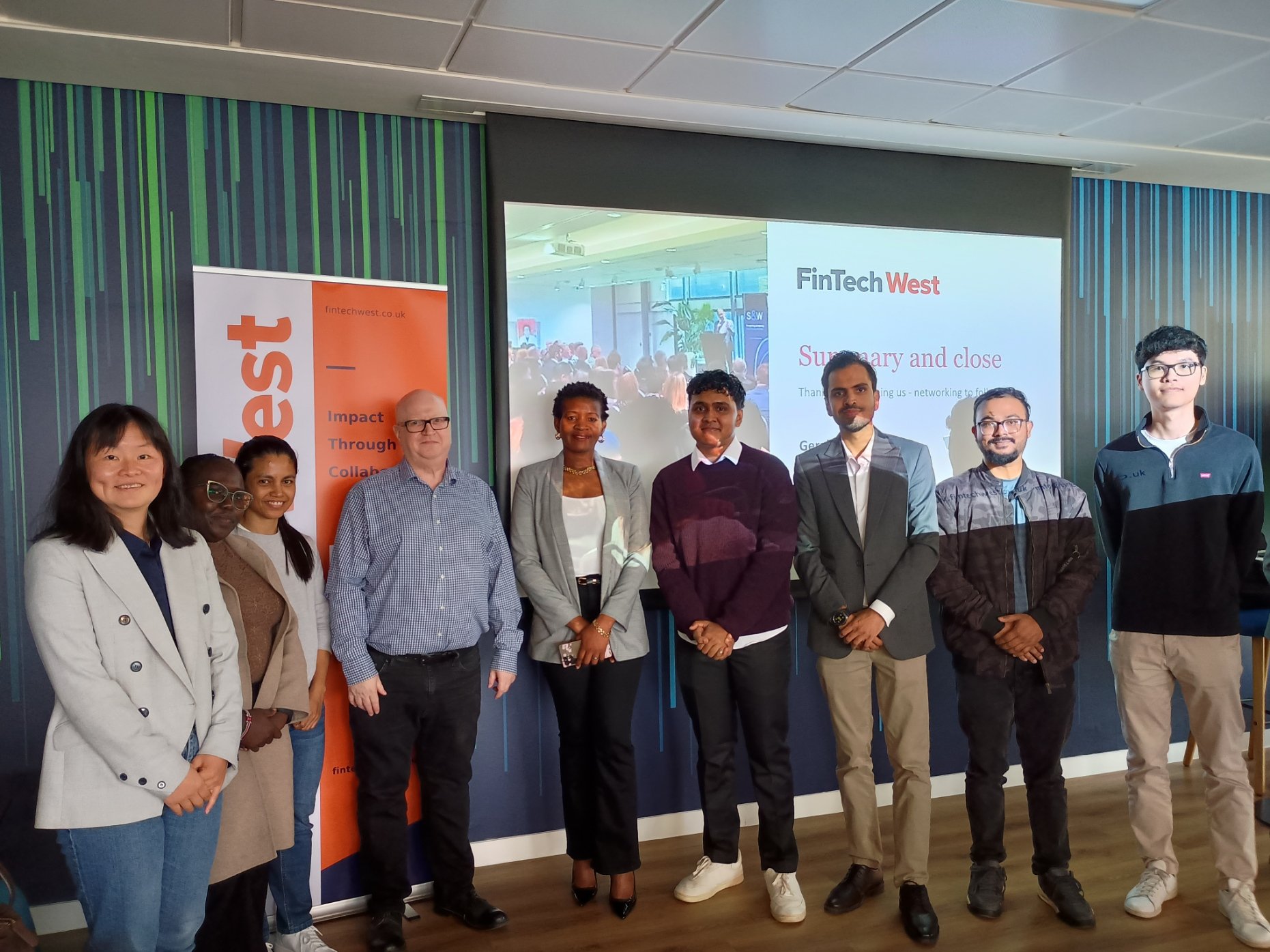
At FinTech West we spend a significant amount of time connecting universities, students and industry from industry projects and research collaboration through to events, spinouts and wider innovation activity. If your organisation has a challenge students could help investigate, wants to engage more closely with one of our university partners or simply wants to understand the opportunities available, please get in touch at info@fintechwest.co.uk.
And if you are not already part of the FinTech West community, you can join through the form at the bottom of the website. It is entirely free.