
Last Thursday, industry leaders gathered in London at Moody's offices for a landmark discussion hosted by Innovate Finance, marking five years since the publication of the Kalifa Review of UK FinTech.
The event brought together policymakers, regulators, CEOs and ecosystem leaders to assess progress and to confront the strategic choices facing the UK over the next five years.
As a regional representative body for FinTechs across the South West and beyond, FinTech West sees this moment not as reflection alone, but as a call to coordinated action.
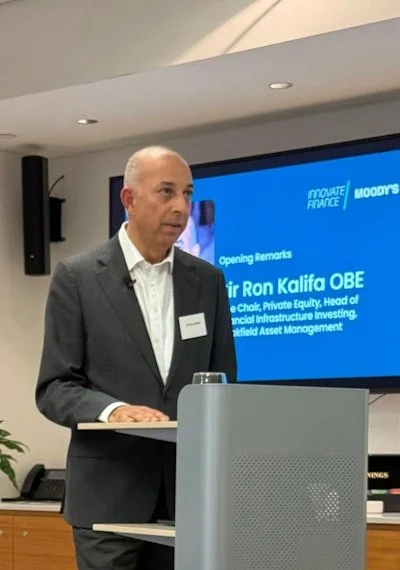
Sir Ron Kalifa OBE
From Vision to Infrastructure
When the Kalifa Review was published, its ambition was clear: to make the UK the best place in the world to start, scale and list a FinTech business.
Five years on, there is significant progress to recognise.
FinTechs and alternative lenders now account for approximately 60% of SME lending in the UK.
Eight in ten UK adults use at least one FinTech tool regularly.
The UK remains Europe’s leading FinTech hub and second globally for investment.
Regulatory innovation, including the FCA sandbox, has become internationally recognised best practice.
FinTech is embedded within the UK’s Industrial Strategy as a high-growth sector.
Crucially, FinTech has evolved from a disruptive challenger to national economic infrastructure. It underpins SME lending, powers payments, drives competition and advances financial inclusion.
The Strategic Inflection Point
As Ron Kalifa emphasised, “Leadership is not a trophy you put on a shelf, it is a position you defend every day.”
Several critical challenges emerged:
1. Pace of Delivery
The UK pioneered open banking, but other markets, including Brazil and India, have accelerated adoption and commercialisation.
Open finance, digital ID and smart data frameworks have been set in motion, yet execution must now follow ambition. In an environment where technology cycles move faster than policy cycles, the ability to reduce friction and accelerate implementation is essential.
The metaphor used in the room resonated strongly: the UK has laid the railway tracks, it must now run the trains.
2. Capital and Scale
While international capital continues to flow into UK FinTech, domestic institutional investment remains underdeveloped.
The Mansion House reforms represent a significant opportunity to mobilise UK pension capital into high-growth sectors. However, the pace and scale of deployment will be critical.
To build truly global FinTech champions headquartered in the UK, long-term patient capital must be aligned with growth ambition.
3. Global Competitive Pressure
Competition is intensifying.The UK has an opportunity, particularly in areas such as stablecoins and digital financial infrastructure.
The EU has progressed digital asset regulation. The UAE and India are accelerating FinTech investment and infrastructure. The US is moving forward with digital asset frameworks.
4. Talent and the Founder Environment
Entrepreneurial risk-taking must be matched by a supportive policy environment.
Founders are globally mobile. Capital is globally mobile. Talent is globally mobile.
Ensuring competitive tax frameworks, accessible scale-up support, and joined-up regulation is central to retaining the next generation of FinTech leaders.
The Role of Regions in the Next Phase
For FinTech West, one message stood out clearly, national leadership depends on regional strength.
Regional FinTech clusters bring:
Deep links to local SMEs and growth sectors
University and research partnerships
Talent pipelines
Embedded innovation in real-economy industries
If FinTech is infrastructure for the digital economy, regional ecosystems are the distribution network.
From Proving Leadership to Defending It
The first five years following the Kalifa Review were about proving that the UK could lead.
The next five years are about defending and extending that leadership.
This will require:
Relentless focus on delivery and pace
Stronger collaboration between government, regulators and industry
Mobilisation of domestic growth capital
Acceleration of open finance and digital identity
Competitive positioning in digital assets and financial infrastructure
A clear national narrative linking FinTech to economic growth and societal benefit
FinTech is no longer a sub-sector. It is foundational to how the UK economy functions and competes globally.
As a regional representative body, FinTech West will continue to champion collaboration and impact, ensuring that the South West plays a full and visible role in shaping the UK’s next chapter in financial innovation.